How Growing Companies End Up With More People and Less Accountability
We’ve all read headlines of “corporate restructuring” – nameless bosses at enormous corporations simply moving names around on a spreadsheet, and thousands of lives upended on the other end of that decision. For years, I thought this maneuver was reserved for only the largest companies – until I had to do it in my business of only 40 people. Going through this more than once as a co-founder, I reached a conclusion:
Sometimes when you grow, you just need new people, not more people.
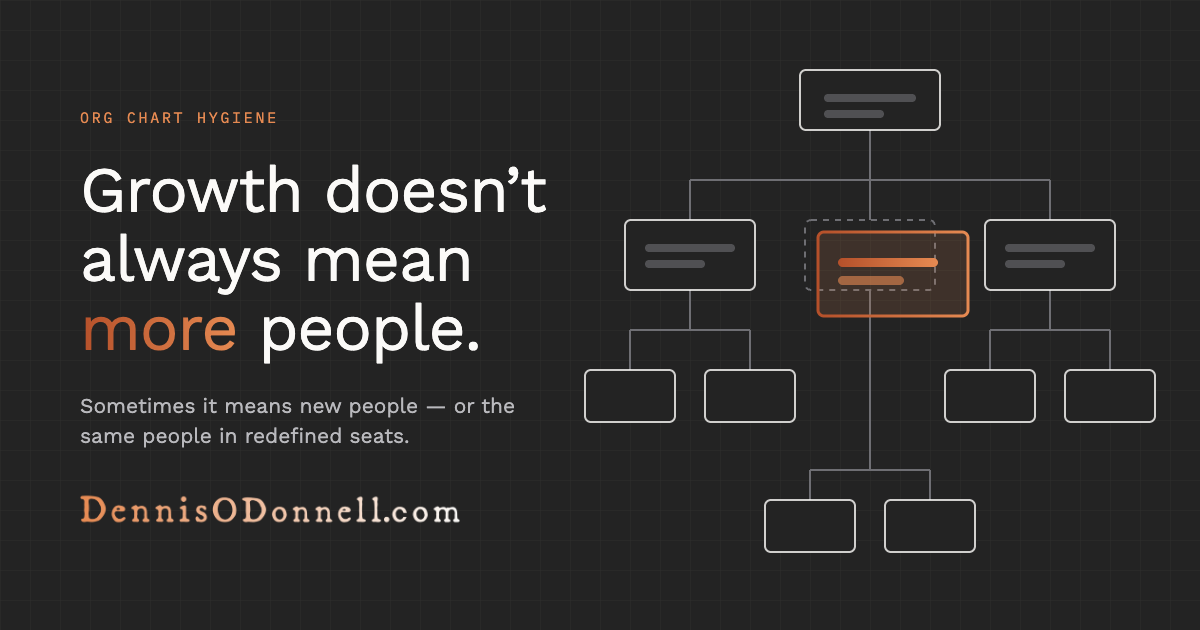
And sometimes you need the same people in redefined roles. The mistake is assuming that growth automatically means adding headcount. Org chart hygiene is how you tell which one you need – and when the answer really is more people, it keeps the rest of the chart from drifting.
The structure of a business often fits a particular stage of its growth – the seats in the company, and the people in those seats, are perfect at $5 million in revenue. But at $8 million, some of those seats have changed – they changed right under the people sitting in them, and they aren’t necessarily the right person for that seat anymore.
The pattern I most often see is that another role or two is added, new people are hired, and at the same time other existing seats end up with new or different responsibilities. The question everyone asks is “Can the person in this seat do the job?” – the answer is often “yes”. But that framing is super important – “can they do it” is a much weaker question than a rigorous evaluation like GWC – “Do they get the new role? Do they want it? Do they have the capacity to do it?”
That level of rigor is usually found in hiring, but rarely used when a role at a company is re-written while the person is still sitting in the seat.
I’ll share a story from my history where this happened. Our company grew 30%, and as a result, we added 2 software engineers to the 1 engineer we had at the time. We rigorously vetted the two new software engineers. However, even without consciously doing so, the role for our original engineer changed. They went from being hired as a generalist, lone wolf to being a member of a team of 3. Specialization became increasingly important. Coordinating work, communicating decisions, and sharing ownership went from a small part of the job to a major part of it. And all of this was without any change in title or official role. I didn’t fully evaluate this change at the time – I’m sharing here so you don’t make the same mistake.
The result of this pattern is predictable. After 2 or 3 rounds of this, you end up with way more people than you planned, and some of the people that have been at the company for years are in roles they aren’t well suited to, so they’re not putting out world-class work. Eventually, this shows up in ways you can’t ignore: flagging profitability, poor customer experience, or a culture that’s starting to fade. These force you to look at the team holistically, and the “corporate restructuring” is born.
It happens at 100,000 employees, 100 employees, and even at 12 employees – this isn’t a phenomenon reserved for big companies – it’s what occurs at changing companies…which is all of them. The corporate restructuring image I opened this article with doesn’t always have to happen – watching for the seats that changed under people allows for smaller, more frequent changes – and far fewer overhaul restructurings. That software engineer example didn’t automatically call for replacing anyone. It called for formally redefining the role, discussing the new expectations, and evaluating what support – or changes – were needed.
This is what I mean by “org chart hygiene” – you could skip basic maintenance on your house and then do a gut renovation every 15 years – that’s the corporate restructure. Or, you could do simple, small updates regularly, and mostly avoid that. I say “mostly” – there are circumstances that can precipitate a complete restructuring, and no amount of hygiene will prevent it (macro conditions, bankruptcy, debt defaults, etc.) Here are some take-aways to help spot these issues and prevent them:
- Right now, today, take a look at key roles and the people in those roles. Does each of these people, without reservation, “get it”? Do they “want it” – not “do they want a job” – do they absolutely want the role they’re in at their core? And do they have the capacity to do it – the experience, training, and bandwidth to crush it? If all three of these aren’t a 100% “hell yeah”, you’ve got to make a change. That change might be clearer expectations, training, a different seat, or a different person.
- Before adding any new positions, explore whether the person doing the job has too much on their plate, or whether parts of the role aren’t a good fit for them. An excellent person who’s overloaded may need another set of hands. But if you’re hiring someone to work around a mismatch, take a hard look at the existing role and the person in it first.
- Every time you add a new position, also flag and discuss what other roles have changed as a result. Be honest with yourself as to whether the other roles that changed are truly their own seat anymore. Adding 2 new jobs might also mean combining or eliminating an existing seat.
- Pull out a blank piece of paper annually and re-draw an org chart for the company you have today, and leave the names off of it – just lay out roles. Then compare to what you have. You will likely end up needing to make some small changes, which is much better than a big restructuring later.
The first two take-aways tell you which one you need. The last two keep the chart from drifting as you grow. None of it is dramatic – that’s the point.
If you’re starting to suspect your company has outgrown its structure – or you’re already facing a restructuring and feeling overwhelmed – let’s talk. I’ve been there more than once.